Mechanism is the product boundary.
A Chiral plugin starts with a governing equation. The equation constrains the signal path, the parameters, and the kinds of motion the effect can produce.
Chiral Audio glossary
This glossary defines the scientific vocabulary behind the catalog. Each entry begins with the mechanism, then names the audio consequence: how a control parameter changes behavior, why the response is nonlinear, and where the equation becomes audible.
A Chiral plugin starts with a governing equation. The equation constrains the signal path, the parameters, and the kinds of motion the effect can produce.
Coupling, carrying capacity, dispersion, and temperature are not cosmetic names. They are levers that move a system through defined behavioral regimes.
A mathematical mapping only matters when a musician can hear it. The catalog favors mechanisms with clear sonic consequences and broad performable range.
The catalog
Eight instruments ship today. The three panels below are the clearest mappings, coupled oscillator synchronization, logistic resonance growth, and nonlinear wave propagation, each an entry point into the larger vocabulary.
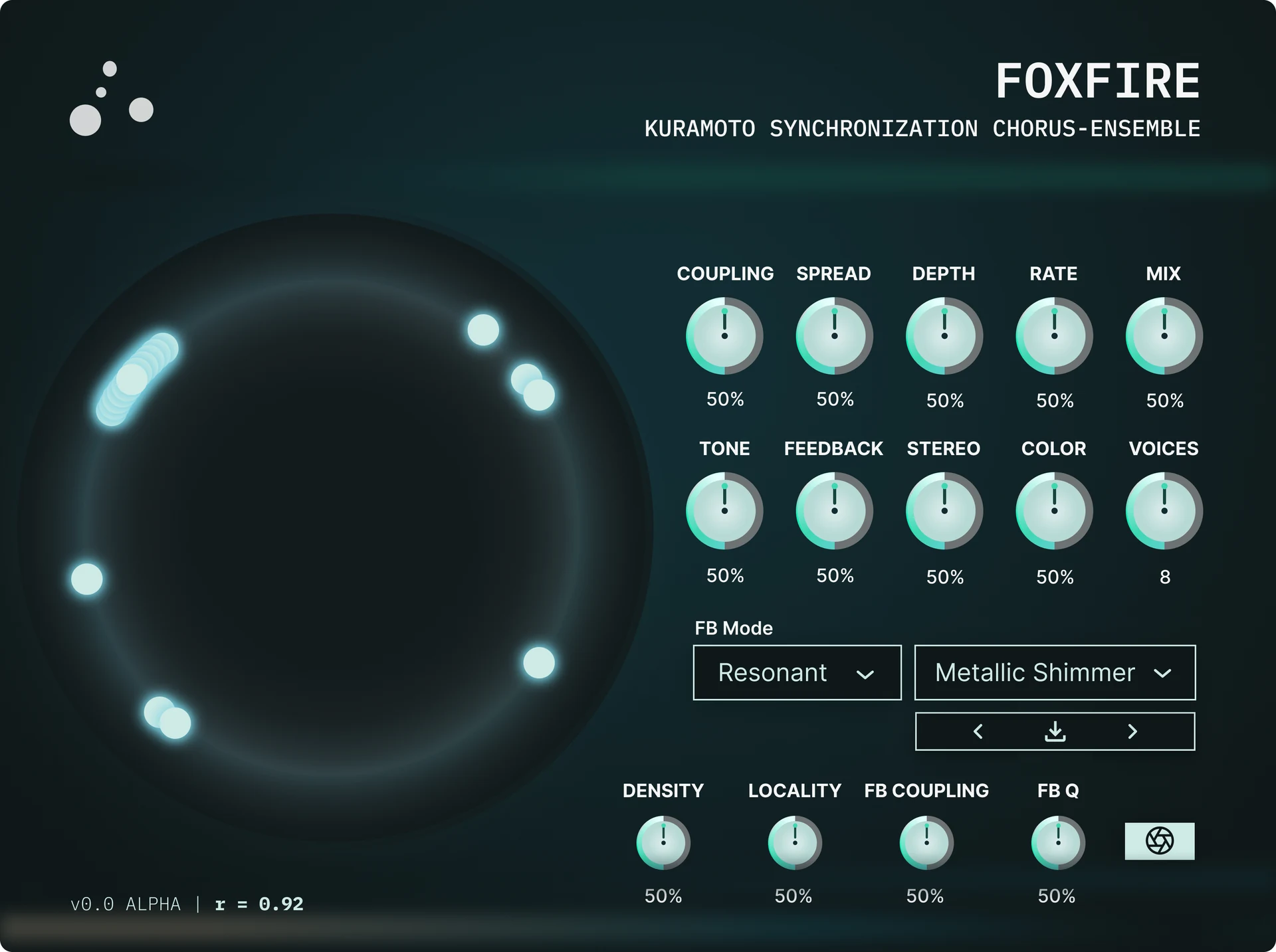
Sixteen voices exchange phase information. Below critical coupling they drift. Near the threshold they flicker into partial coherence. Above it they lock.
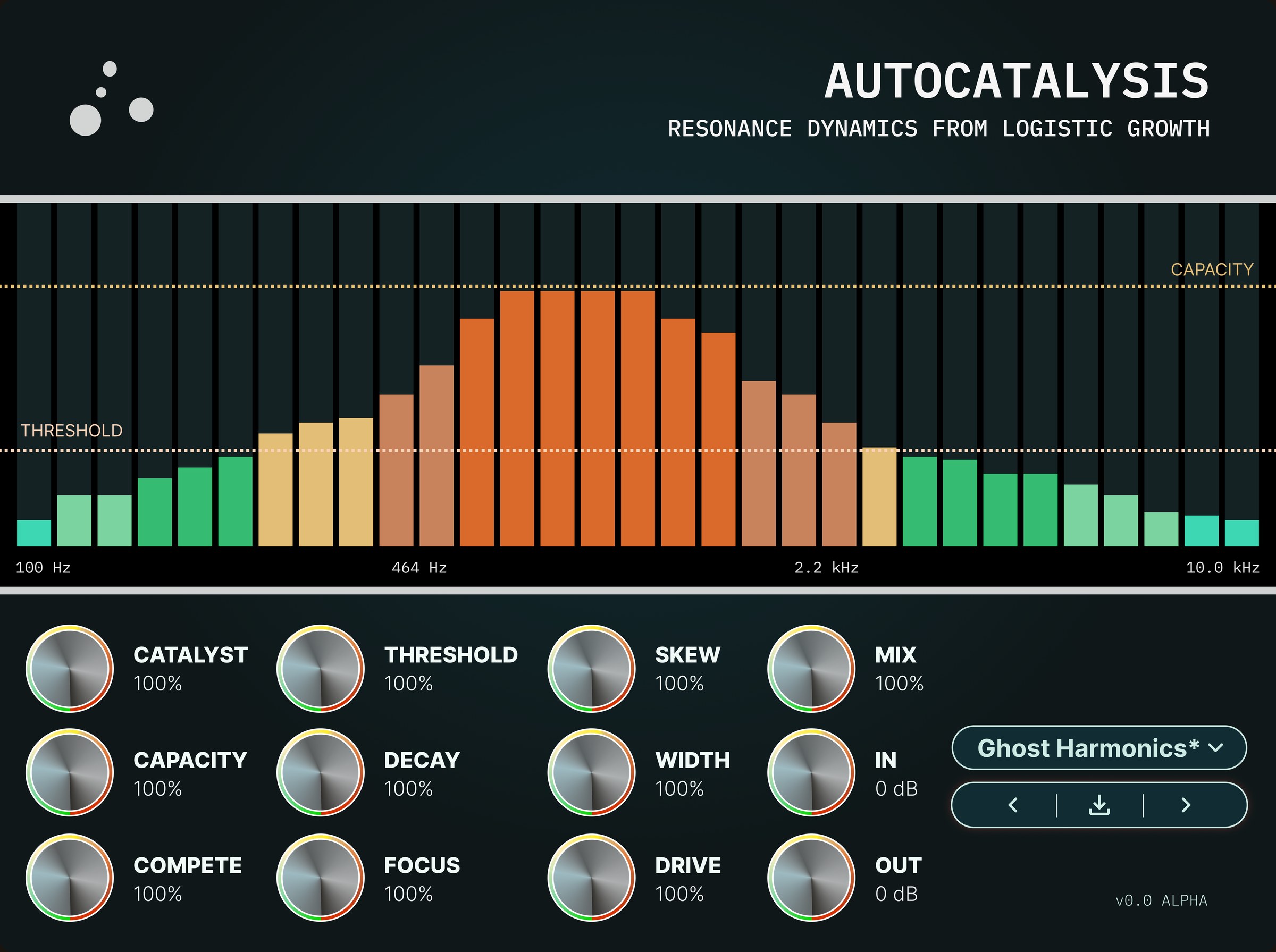
Resonators recruit themselves through an S-curve. Growth starts slowly, accelerates, then saturates against a capacity limit.
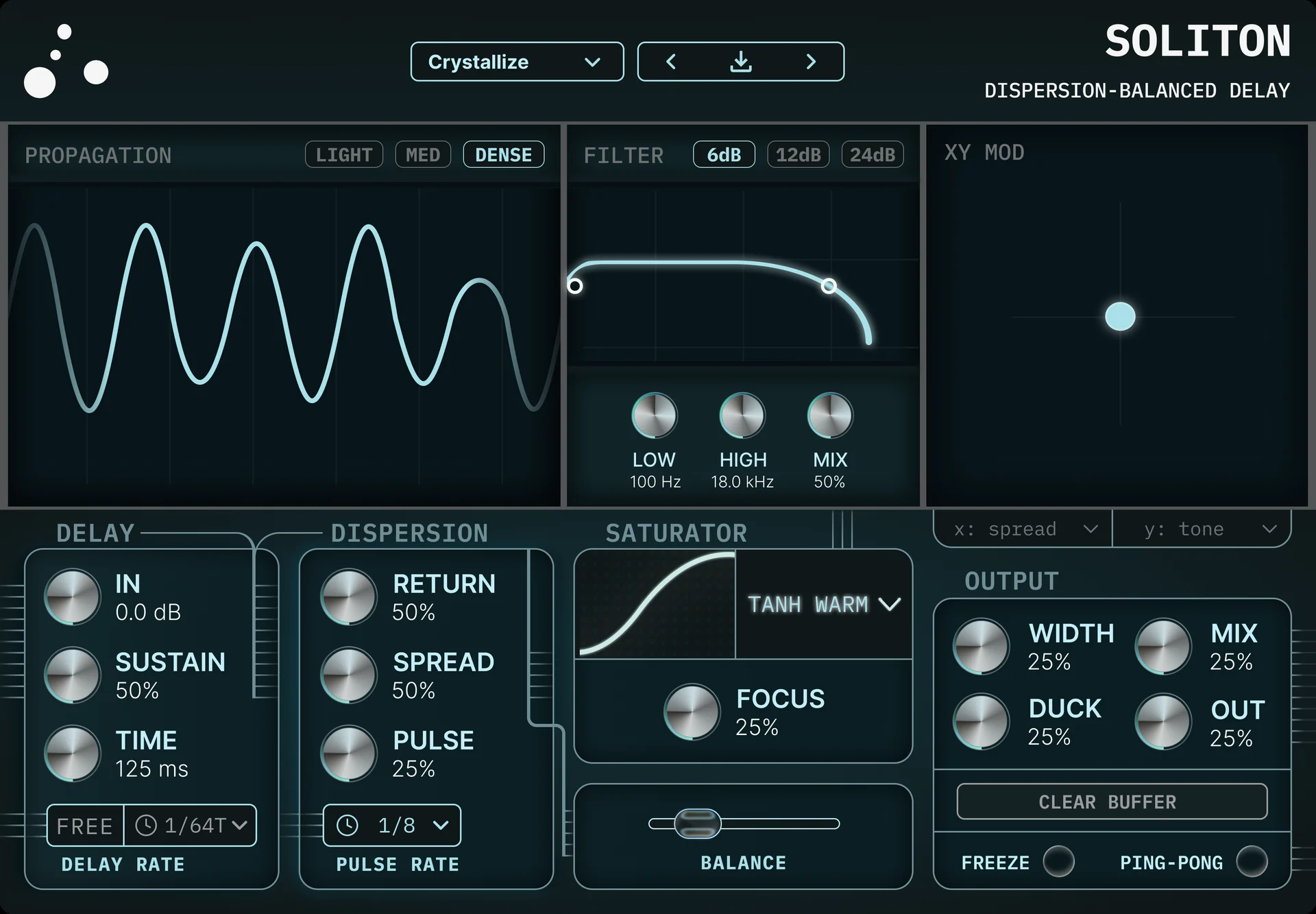
Dispersion spreads the repeat. Saturation refocuses it. At the balance point, the delay line sustains without collapsing into smear or runaway feedback.
No terms match that search.
Structural isomorphism is the requirement that the organization of a source phenomenon maps cleanly onto the organization of the DSP. The scientific system supplies the signal path, state variables, constraints, and parameter meanings.
Audio consequence: the effect inherits behavior from the mechanism itself. A coupled-oscillator chorus can drift, cluster, and lock because those are native behaviors of the Kuramoto model.
The equation that defines how a system changes over time. In this catalog, the governing equation is the design object: it determines state update, stability, feedback, and the meaningful parameter ranges.
Audio consequence: a control is strongest when it corresponds to a real term in the equation. Coupling, capacity, dispersion, and temperature carry more authority than arbitrary macro labels because they name actual system levers.
A variable that changes the regime of a system. Temperature moves a material through a phase transition. Coupling moves oscillators from incoherence toward synchronization. Capacity limits a self-amplifying reaction.
Audio consequence: a good control parameter does more than add more effect. It changes the kind of behavior the listener hears.
A compact measure of macroscopic order. In a Kuramoto network, the order parameter R measures phase coherence across the oscillator population. R near zero means incoherence. R near one means synchronized motion.
Audio consequence: an order meter can show the ensemble cohering while the ear hears the chorus tighten.
The study of systems whose response is not proportional to input. Doubling the input does not simply double the output. Thresholds, saturation, hysteresis, phase transitions, and self-reinforcing feedback all require nonlinearity.
Audio consequence: nonlinear systems produce qualitative changes: a chorus snaps toward coherence, a resonator blooms after the attack, a delay stabilizes into a persistent wave.
An abrupt change in system-level behavior as a control parameter crosses a critical value. Water freezes. Magnets order. Oscillators that drift independently begin to synchronize when coupling crosses the threshold.
Audio consequence: the transition zone is performable. In Foxfire, the Coupling knob moves the chorus through incoherence, flickering partial sync, and locked motion.
The coupling strength at which a finite fraction of oscillators begins to synchronize. Below this value the population remains mostly incoherent. Above it, the order parameter rises as the network coheres.
Audio consequence: critical coupling is the dramatic hinge in a coupled-oscillator chorus. It is where motion starts to feel intentional without becoming rigid. See the longer Kuramoto synchronization explainer.
An oscillator whose phase or amplitude is influenced by other oscillators. Coupling can produce entrainment, clustering, traveling waves, and synchronized motion, depending on network structure and coupling strength.
Audio consequence: voices stop behaving as isolated LFOs. They become a population with collective motion.
A model of how oscillators with different natural frequencies self-organize when they exchange phase information. In its common mean-field form, each oscillator follows \(\dfrac{d\theta_i}{dt} = \omega_i + \dfrac{K}{N}\sum_{j} \sin(\theta_j - \theta_i)\).
Audio consequence: Foxfire uses this model to make a chorus that can drift, cluster, flicker at the threshold, and lock as a system. Read the full audio explanation or the practical comparison.
A point where a system changes the number or stability of its possible behaviors. Below the bifurcation, one regime is stable. Across it, a new regime appears or an old one disappears.
Audio consequence: bifurcations are useful for controls that should cross from following to oscillating, or from stable to unstable, with a clear threshold.
History-dependent response. A hysteretic system does not return along the same path it took in. Magnetic materials show this as a loop between field strength and magnetization.
Audio consequence: distortion can remember recent signal motion. The transfer curve becomes path-dependent, which creates weight, lag, and asymmetric recovery.
A reaction where a product also catalyzes its own formation. Each unit of product increases the rate at which more product appears, until substrate limits or carrying capacity slow the reaction.
Audio consequence: resonators can grow from the signal they detect. Harmonics emerge after the initial event instead of merely decaying from it.
A growth model where the rate depends on both current population and remaining capacity: \(\dfrac{dN}{dt} = rN\!\left(1 - \dfrac{N}{K}\right)\). Growth begins slowly, accelerates, then saturates into an S-curve.
Audio consequence: a resonant band can bloom with a physical time profile: lag, ignition, and self-limiting ceiling.
The differential equation for logistic growth, published by Pierre-Francois Verhulst in 1838. It refines exponential growth by adding a capacity term that slows growth as the system fills.
Audio consequence: the Verhulst shape gives Autocatalysis its controlled bloom. It grows with force, then stops where the model says it must.
The maximum state a growth process can sustain under its constraints. In logistic growth it is the K term, the ceiling that converts runaway exponential growth into bounded S-curve behavior.
Audio consequence: capacity sets how far resonance can bloom before it self-limits. It is the difference between growth and uncontrolled feedback.
A class of systems where local reactions and spatial diffusion act together. The result can be self-organizing patterns: stripes, spots, chemical waves, and morphogenetic gradients.
Audio consequence: reaction-diffusion is useful when spectral or spatial material should organize itself from local interactions rather than a global modulation curve.
A solitary traveling wave that preserves its shape because dispersion and nonlinear steepening balance. The wave resists the usual fate of broadening, decaying, or breaking apart.
Audio consequence: Soliton uses the balance principle inside a feedback delay. Repeats reshape themselves instead of degrading into mush or screaming into runaway feedback.
Frequency-dependent propagation speed. In a dispersive medium, different frequency components travel at different rates, so a complex wave spreads over time.
Audio consequence: allpass dispersion can smear a delay repeat in a controlled way. Balanced against saturation, the same force that would blur the signal helps create a stable repeat.
The speed at which a wave packet's envelope moves. It differs from phase velocity, which tracks the movement of individual wave crests. Dispersive media separate these speeds.
Audio consequence: group velocity matters when delay lines and wave packets are treated as moving structures, not only as time offsets.
A nonlinear partial differential equation for shallow-water waves, commonly written \(u_t + 6u\,u_x + u_{xxx} = 0\). The nonlinear term steepens the wave. The dispersive term spreads it. Soliton solutions appear where those forces balance.
Audio consequence: the KdV equation supplies the conceptual spine for a delay that stabilizes through dispersion and nonlinearity rather than brute-force feedback.
A probability distribution where lower-energy states are exponentially more likely than higher-energy states: \(P(E_i) = \dfrac{e^{-E_i/kT}}{Z}\). Temperature controls how sharply the system favors low-energy states.
Audio consequence: pitch or rhythm selection can move continuously from stable and tonal to high-entropy and exploratory. See the full Boltzmann distribution explainer.
The quantity that normalizes the Boltzmann distribution: \(Z = \sum_i e^{-E_i/T}\). Summing the exponential weight of every state turns raw energies into probabilities that sum to one.
Audio consequence: every pitch's odds are measured against the whole field, so raising one note's probability lowers the rest. The histogram you see is the distribution after dividing by Z.
In statistical mechanics, temperature sets the width of a distribution rather than a single value. Low temperature concentrates probability on the lowest-energy states; high temperature spreads it toward equal odds.
Audio consequence: one knob runs an entire pitch field from frozen on the root to evenly random. Read the Boltzmann distribution explainer.
A single, fully specified configuration of a system. A macrostate is everything that looks the same from the outside, and many microstates can share one macrostate. Counting them is the root of entropy.
Audio consequence: a locked phrase is one microstate of the generator. Reseeding draws another microstate from the same distribution.
A measure of how spread out a distribution is. The Gibbs and Shannon form \(S = -\sum_i p_i \ln p_i\) peaks when every state is equally likely; Boltzmann's form \(S = k\ln W\) counts equally likely microstates.
Audio consequence: entropy reads as unpredictability. Cold settings are low-entropy and tonal; hot settings are high-entropy and exploratory.
The lowest-energy configuration of a system and, in the Boltzmann distribution, the most probable one. As temperature falls, probability collapses onto it.
Audio consequence: in Boltzmann the root is the ground state, so cold settings return to it again and again.
A way to sample a distribution by random walk: propose a step, then accept it with probability \(\min\!\left(1,\, e^{-\Delta E/T}\right)\). Downhill moves are always taken; uphill moves are taken sometimes.
Audio consequence: sampling by small steps gives a melodic contour with the same distribution as independent draws, but the line moves by neighbors instead of leaps.
The distribution of molecular speeds in an ideal gas at temperature T. Few molecules are very slow or very fast, and the spread widens while the peak shifts higher as the gas heats.
Audio consequence: the same exponential-in-energy law that shapes gas speeds shapes which pitches a generator is likely to play. See statistical thermodynamics.
What happens when a supercooled liquid falls out of equilibrium because cooling outruns structural relaxation. Crystal and glass are two endpoints of the same race: cool slowly enough and the material finds the ordered crystal, cool faster than the relaxation time and disorder freezes in as glass.
Audio consequence: Anneal runs this race on every note. The same TEMP setting can resolve as a tuned crystal or scattered glass depending on how it got there. See the glass transition research note.
Introduced by Tool in 1946: the temperature at which the frozen structure would be the equilibrium one. It encodes the cooling trajectory, not the instantaneous reading. Its drift is \(dT_f/dt = (T - T_f)/\tau(T)\): the structure chases equilibrium at a rate set by the relaxation time, and whatever \(T_f\) it is holding when the chase stops is what the material remembers.
Audio consequence: Anneal's telemetry reads \(T_f\) directly. Same final TEMP, same knob position: an 8-second cool lands \(T_f\) at 0.526 (crystal, 0.95 cents of frozen spread), a 30 ms quench lands it at 0.874 (glass, 17.28 cents). The knob position never tells you which one you got.
The Arrhenius-activated timescale a material needs to rearrange toward equilibrium at a given temperature: \(\tau(T) = 5.0\times10^{-5}\,e^{5.298/T}\) in Anneal's model. It is the same exponential-in-temperature law as the Arrhenius equation and activation energy, applied to configurational rearrangement instead of a chemical reaction.
Audio consequence: whether a cool counts as fast or slow is relative to \(\tau(T)\), not to the clock. Below Tg, \(\tau\) stretches long enough that any musically reasonable RATE outruns it, which is why frozen glass below Tg shows 0.0% relaxation over 25 seconds.
Cooling faster than the structural relaxation time \(\tau(T)\), so the material cannot rearrange fast enough to track equilibrium and disorder freezes in. In Anneal, QUENCH is the literal control: a 30 ms snap-cool.
Audio consequence: the quenched state measures 17.28 cents of frozen spread, \(T_f\) 0.874, crystallinity 0.288, median beat 8.48 Hz: glass, audibly rougher and more detuned than the same TEMP reached slowly.
Cooling slowly, or parking warm, so structural relaxation keeps pace with the temperature change and the material relaxes toward the ordered crystal instead of freezing disorder in. The ANNEAL creep band (roughly 30 to 42 percent TEMP) is where this self-healing is fast enough to hear happen in seconds.
Audio consequence: the annealed state at the same final TEMP as a quench measures 0.95 cents of frozen spread against the quench's 17.28: an 18x difference in outcome from a rate change alone, nothing else in the signal path moved.
The same control position producing a different state depending on the history that led there. This is hysteresis applied to a thermal trajectory rather than a magnetic field: sweeping Anneal's TEMP as a triangle traces a loop with nonzero area (1.13 to 1.33 cent·T in Anneal's units), because the down-leg at a given temperature freezes 1.75 to 2.75 times more disorder than the up-leg passed through on the way there.
Audio consequence: a memoryless control built from the same equilibrium map, with no path term, scores exactly zero loop area and exactly zero on every path metric: it cannot be sometimes-crystal, sometimes-glass at the same knob position, which is the whole proof that history, not position, is doing the work. See the path-dependence research note.
A mean-reverting stochastic process: a state decays exponentially toward a target while noise keeps perturbing it, settling into a stationary distribution whose width is set by the balance of the two. Anneal updates each mode's configurational deviation \(d\) with the exact discretization \(d \leftarrow a\,d + \mathcal{N}(0,1)\sqrt{\mathrm{var}_{eq}(T)(1-a^2)}\), where \(a = e^{-dt/\tau(T)}\).
Audio consequence: because the discretization is exact rather than approximated, the update is unconditionally stable at any block size or sample rate, and the frozen spread it produces is the real equilibrium width for that temperature and relaxation time, not a tuned-by-ear approximation of one.
A glass parked below its transition, slowly creeping toward equilibrium even without a deliberate anneal step, because \(\tau(T)\) at that temperature is finite rather than effectively infinite. Anneal's quench-then-park case at T = 0.45 heals frozen spread from 21.98 to 0.57 cents and beat from 19.45 to 0.58 Hz over 25 seconds, with a fitted creep constant of 6.5 seconds that matches the Arrhenius prediction directly.
Audio consequence: a quenched glass audibly settles while it sits, self-healing toward the crystal without a new gesture from the player. Park it cold enough (T ≤ 0.20) and the aging stops: 0.0 percent relaxation in 25 seconds, a permanent glass.
The energy barrier a process must clear before it can proceed, written \(E_a\). In the Arrhenius law \(k = A\,e^{-E_a/RT}\) it sits in the exponent, so a small change in barrier or temperature moves the rate by a large factor.
Audio consequence: Arrhenius gives every band its own barrier, and only the collisions that clear it open the gate, so raising temperature reconstructs a loop energy-first. The BARRIER control is \(E_a\) directly.
The law that sets how fast a reaction runs: \(k = A\,e^{-E_a/RT}\), where \(A\) is the attempt frequency, \(E_a\) the barrier, and \(T\) the temperature. Because temperature enters through an exponential, rate is hypersensitive to it across a narrow span.
Audio consequence: the plugin implements the law literally, not as a metaphor. Eight bands fire at the density the equation predicts, so one octave of TEMPERATURE moves event density by orders of magnitude. That narrow sensitivity zone is the instrument.
The proportionality \(k\) in a rate law: how many successful reactions occur per unit time at a given temperature and barrier. It is the output of the Arrhenius equation, not an input.
Audio consequence: \(k\) is the firing rate of the gate. The readout strip reports k THEORY, the rate the law predicts, against k-HAT, the rate actually measured, so the reaction stays legible as you move the controls.
The factor \(A\) in the Arrhenius law: the rate at which collisions are attempted, before the exponential term decides how many succeed. It sets the ceiling the temperature term works against.
Audio consequence: the RATE control is \(A\), the attempt clock. Free-running it is a frequency in hertz; under SYNC it follows a tempo division, so the reactions land on the grid.
The picture behind the rate law: reactant particles collide constantly, but only collisions carrying more than the activation energy convert to product. Raising temperature raises the fraction of energetic collisions.
Audio consequence: the COLLISION control keys each band's success to that band's own energy, so loud hits clear the barrier that quiet passages cannot. The gate then grooves with the source instead of firing at random.
A substance that lowers the activation barrier of a reaction without being consumed by it, raising the rate while leaving reactants and products untouched.
Audio consequence: CATALYST lowers the per-band barrier, so a frozen mix melts as you raise it, while AFFINITY selects which end of the spectrum the catalyst binds: highs shimmer through the ice, or bass tunnels under it.
A reaction that releases heat. When that heat raises the temperature of the vessel, it raises the rate, which releases more heat: a feedback loop that produces induction periods and ignition.
Audio consequence: EXOTHERM feeds reaction energy back into the effective temperature, fueled by the input. Sustained signal can ignite into a denser texture, then cool the Newtonian way once the input stops feeding it.
The single axis that traces a reaction's progress from reactants, up over the activation barrier at the transition state, and down to products. The height of the ridge is the energy that must be paid to proceed.
Audio consequence: the left viewport draws this coordinate, the energy ridge from reactants over the barrier to products, with the live attempt rate climbing it. The right viewport is the Arrhenius plot; drag it to set temperature directly.
Wave trapping caused by disorder. Instead of diffusing freely through a medium, a wave becomes localized because random scattering prevents long-range propagation.
Audio consequence: a spectral freeze can become gradual and material-like. Disorder determines which bands stay trapped and which bands keep moving.
The inhibition of state change by frequent measurement. In quantum mechanics, repeated observation can prevent a state from evolving away from its measured condition.
Audio consequence: measurement rate becomes a hold control. In a Zeno-style freeze, faster per-band capture keeps spectral material still; slower capture lets motion return.
A boundary between extended states that can propagate and localized states that remain trapped. It describes where mobility changes across a disordered system.
Audio consequence: a freeze can have a frequency boundary. One spectral region can continue moving while another becomes suspended.
The spacetime solution around a non-rotating spherical mass. The time-dilation term can be read as a clock-rate ratio that decreases as radius approaches the Schwarzschild radius.
Audio consequence: Geodesic uses that clock-rate curve to make near taps slow, stretch, darken, and approach a horizon-like hold.
The lowering of observed frequency when light or a clock climbs out of a gravitational well. In the simplified audio mapping, a lower clock-rate ratio means lower pitch and longer time.
Audio consequence: redshift gives a delay tap persistent downward stretch instead of a one-time pitch drop.
The boundary where the Schwarzschild time-dilation factor tends toward zero for a distant observer. Physical event horizons belong to general relativity; audio implementations should treat the phrase carefully.
Audio consequence: Geodesic uses a horizon-like endpoint as a controlled hold state when a tap's clock rate becomes too slow to read as a normal delay.
The condition where waves reflect constructively from periodic planes in a crystal: \(n\lambda = 2d\,\sin\theta\). Wavelength, lattice spacing, and angle determine which frequencies reinforce.
Audio consequence: frequency bands can be routed through stereo space by diffraction logic, with spacing as the governing control.
An optical property where a crystal splits light into ordinary and extraordinary rays with different refractive indices. The split depends on angle, material, and polarization.
Audio consequence: chorus or comb filtering can split by direction and material profile, producing movement that feels prismatic rather than mechanically periodic.
A periodic arrangement of atoms or ions. Lattice spacing, symmetry, defects, and temperature determine how vibrations propagate through the material.
Audio consequence: an FDN reverb can derive delay ratios, diffusion, and spectral gaps from material structure rather than arbitrary tuning.
Directed movement along a chemical gradient. Cells compare local concentration over time and bias their motion toward stronger or weaker signal depending on the organism and stimulus.
Audio consequence: resonators can wander toward spectral peaks, following the source as if the signal were a gradient field.
Movement across a semipermeable membrane driven by concentration differences. The membrane admits some species, blocks others, and creates pressure when the system is constrained.
Audio consequence: two signals can compete across a spectral membrane, with permeability controlling how much one source occupies the other's space.
Conventional plugin categories describe surface behavior: chorus, delay, reverb, distortion. Chiral's vocabulary is lower in the stack. It names the mechanism that generates the behavior, which is where the defensible difference lives.