Anneal™
A synthesizer whose sound depends on how it was cooled.
dTf/dt = (T − Tf) / τ(T)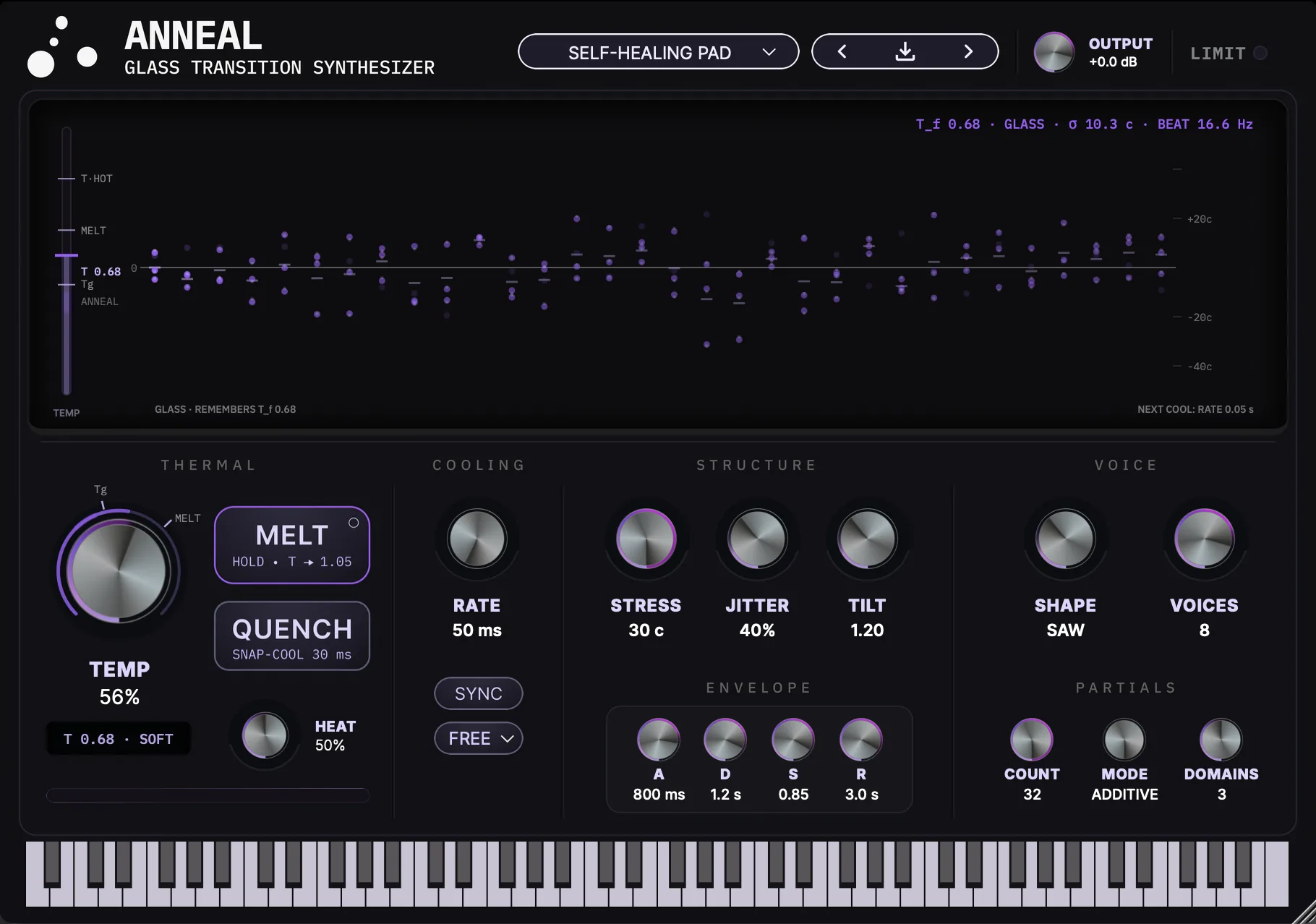 Slab · live lattice scatter
TEMP · MELT / QUENCH
RATE · SYNC cooling column
T_f telemetry line
Slab · live lattice scatter
TEMP · MELT / QUENCH
RATE · SYNC cooling column
T_f telemetry line
This is the plugin's interface. The mechanism behind it: fictive temperature T_f lags true temperature T by a relaxation time τ(T), so the same TEMP position freezes a different disorder depending on how you got there. For the full derivation, read the glass-transition note.
Anneal treats the patch as a slab with a thermal history, not a static detune map. Every mode's configurational deviation follows an exact Ornstein-Uhlenbeck relaxation toward an equilibrium set by T, and the fictive temperature T_f tracks how close that deviation actually got to settling. Cool slowly past T_g and it lands on the crystal; cool fast and it freezes mid-flight as glass. For the deeper technical explanation, read the glass-transition mechanism note or the path-dependence note.
From molten to frozen.
Melt it
Hold MELT or play hard with HEAT engaged. T climbs toward 1.05 and every mode's disorder rises with it.
Choose the cooling rate
RATE sets how long the fall back to TEMP takes, 30 ms to 30 seconds. This single choice decides everything that follows.
It freezes crystal or glass
Cool slowly past T_g and disorder relaxes onto the line. Cool fast and the same disorder freezes in mid-flight. Same TEMP, different sound.
It remembers
Aging heals a quench over seconds in the ANNEAL creep band. MODE MODAL turns that memory into lifetime: order rings longer than disorder.
What Anneal does differently.
Hear it freeze.
Real capturesEach clip is a single continuous take, one oscillator per row. Tilt sweeps run TILT alone; full sweeps move TEMP, STRESS, JITTER, and velocity together.
Tilt sweeps
Full sweeps