Chiral Audio · Catalog V1 · Logistic-growth resonator bank

Autocatalysis

Sixteen tuned bands that feed themselves, then self-limit.

dx/dt = r·x·(1 − x/K)
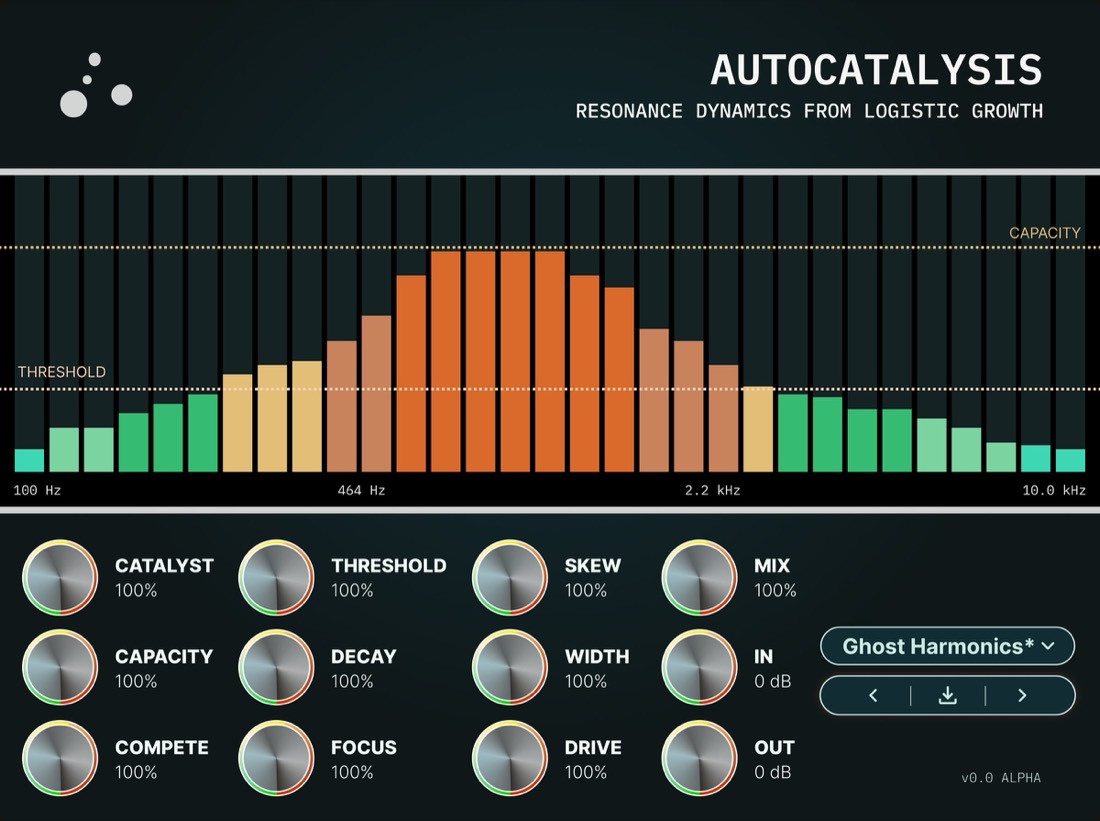
Autocatalysis plugin interface, showing the sixteen-band resonance spectrum with its Threshold and Capacity lines, and the Catalyst, Capacity, and Compete dials Live resonance spectrum Capacity · bloom ceiling Threshold · ignition floor
Live · population x / K
0.12x / K · below threshold

This is the plugin's interface. The mechanism behind it: below threshold the resonators grow slowly, above it they ignite and self-limit on the S-curve, climbing toward capacity. For the science behind the catalog, read the Chiral research notes.

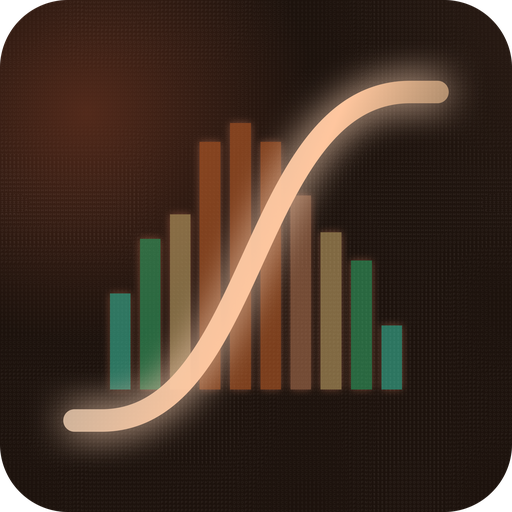
Autocatalysis runs the logistic-growth law dx/dt = r·x·(1 − x/K) across sixteen tuned resonators. Only frequencies already present in the signal climb the curve, so bloom, saturation, and decay are consequences of the math rather than a static boost. Push Compete and the bands take energy from each other, Lotka−Volterra style, until the spectrum breathes on its own.

From a quiet seed to a self-limiting bloom.

01 · seed

Track

Sixteen tuned bands listen to what is already in your signal. Silence stays silent.

02 · bloom

Grow

Below threshold, present frequencies bloom slowly along the logistic curve.

03 · saturate

Self-limit

Above threshold they ignite, then hit a ceiling derived from the math, not a clip.

04 · compete

Take turns

Compete lets bands steal energy from each other, oscillating across the spectrum.

What Autocatalysis does differently.

An S-curve, not a boost.
Bands start slow, surge, then self-limit, the same three-phase arc that describes bacterial populations, chemical autocatalysis, and viral spread. The ceiling comes from the capacity term, not a clip.
Threshold-gated growth.
Only frequencies already in the signal bloom. Silence stays silent. No hiss, no excitation from nothing, no phantom harmonics introduced where the source has none.
Inter-band competition.
Push Compete up and the strongest resonators suppress their neighbours, Lotka−Volterra style. The result is selective enhancement that tracks the material, not a fixed curve.
Belousov−Zhabotinsky oscillation.
At extreme Compete the spectrum pulses rhythmically from a static input. Bands take turns blooming and fading, and the ensemble breathes on its own.

Hear it bloom.

Each demo pairs the same source dry and processed. Toggle between takes to hear the resonator bands compete.

Saw-square bassline
Saw and square oscillators with velocity-modulated tone, filter, and shaper drive.
0:00

Dry mix.

Drums · kick & snare
Tight loop, kick + snare + closed hats.
0:00

Dry mix.

Drums · hats & rim
Shuffling hats with a noisy rimshot.
0:00

Dry mix.

Drums · hats & clap
Shuffling hats with claps.
0:00

Dry mix.

Drums · techno FX
Quirk FX, open hat, snare.
0:00

Dry mix.

Arp saw lead
Arp saw lead with modulated filter cutoff.
0:00

Modulated saw lead, dry.

Piano · Moving On
Mid-range, mid-velocity piano in B minor.
0:00

Dry piano phrase.

Piano · Promised Neverland
Higher-octave, mid-high velocity piano in D# major.
0:00

Dry piano phrase.

Sustained sine chord
Held sine-wave chord, no transient.
0:00

Dry mix.

What is in the box.

Resonance engine
Sixteen tuned bands from 100 Hz to 10 kHz on a shared logistic capacity. Catalyst, Threshold, Capacity, Decay, Focus, Compete, Skew, Width, Drive. Saturation is a ceiling from the math, not a clip.
Output
Mix, In, Out. Sixteen factory presets, plus your own. Live capacity and threshold lines on the spectrum visualization. Every control position is a valid operating state.
Formats
macOS 11+ VST3, AU, Standalone. Windows 10+ VST3, Standalone. Apple Silicon and Intel native.
Autocatalysis
Catalog V1 · Launch special
$20$30