John Scott Russell matters because he observed a solitary wave decades before the mathematics could explain it. His 1834 canal observation preserved the phenomenon in experimental detail until Korteweg and de Vries derived the equation that made it legible.
The observation
A stopped boat launched a wave that kept going.
Russell was working on canal-boat hydrodynamics in 1834, measuring how hulls moved through the narrow channels between Edinburgh and Glasgow. A horse-drawn boat stopped suddenly. The mass of water gathered at the prow did not collapse into ordinary ripples. It rolled forward as a single rounded elevation and continued down the canal.
In his later report, Russell described it as a "rounded, smooth and well-defined heap of water." He followed it on horseback, estimating a speed of eight or nine miles per hour, a length of roughly thirty feet, and a height between one foot and one and a half feet. After one or two miles, he lost it in the windings of the channel.
Those details are why the story survives as more than scientific folklore. The account gives shape, speed, height, distance, and context. It is not just the image of an engineer chasing water. It is an observation precise enough for later mathematics to recognize.
The setting also matters. The Union Canal was a controlled enough environment to make the observation unusually clean: narrow channel, shallow water, a moving boat, and a sudden stop that injected energy into the water ahead of the prow. Russell was not watching ocean surf or an irregular river. He was watching a constrained hydraulic system during work that already required him to notice resistance, wake shape, speed, and hull behavior.
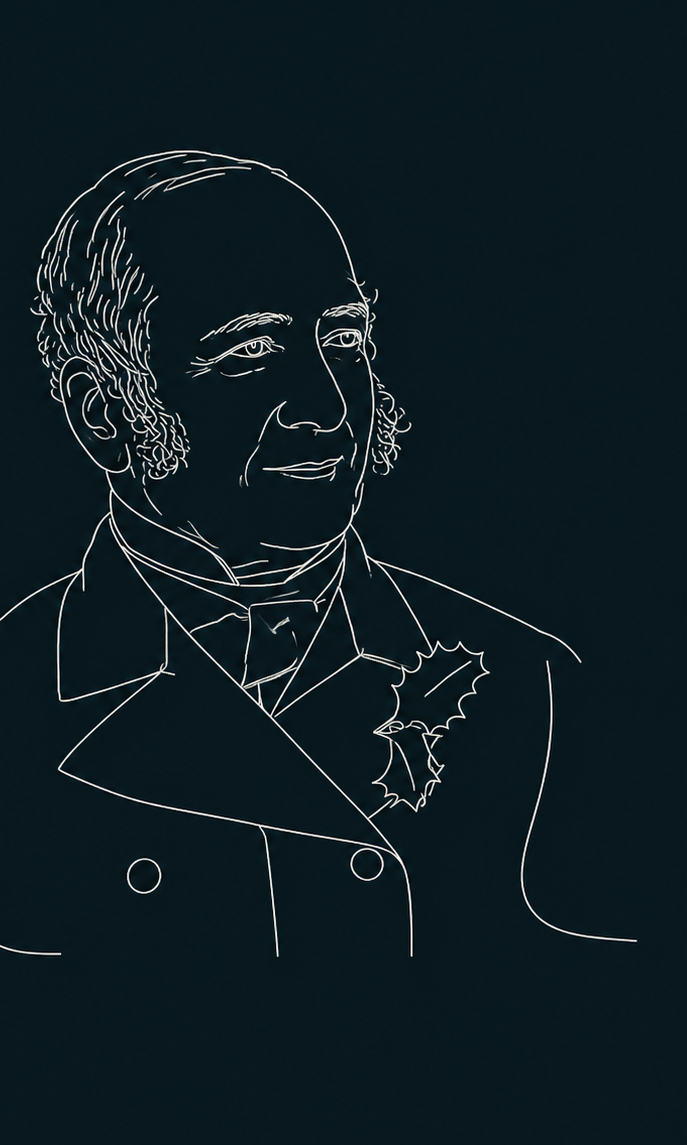
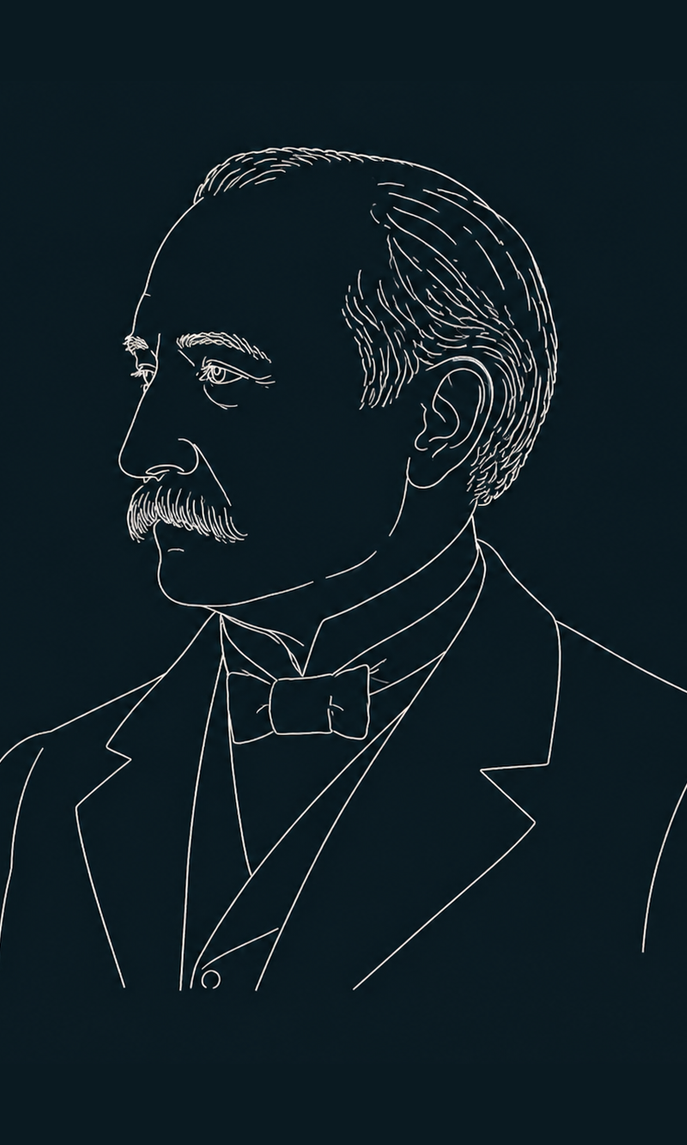
Experiment
Russell built a tank because the canal was not enough.
The canal gave Russell the phenomenon. The tank gave him control. He built channels for generating waves by displacing water and measured how the resulting pulses traveled. The key relationship was simple and disruptive: the wave speed depended on both depth and amplitude.
- \(c\)
- Speed of the solitary wave.
- \(h\)
- Still-water depth of the channel.
- \(a\)
- Wave amplitude above the still-water level.
In ordinary linear shallow-water theory, speed depends primarily on depth. Russell's measurements made amplitude part of the story. Taller solitary waves moved faster. That coupling between amplitude and velocity is the doorway to the later soliton model: shape, height, and speed are not independent decorations. They are linked by the dynamics.
Russell called the phenomenon the wave of translation. The term distinguished it from ordinary oscillatory waves, where water parcels mostly move back and forth while the pattern travels. A wave of translation carried a visible heap forward as a coherent object.
The tank work made the canal observation reproducible. That is the difference between a memorable anecdote and a useful scientific object. Russell could vary water depth, wave height, and channel geometry, then watch the resulting pulse travel. The apparatus was not glamorous, but it forced the phenomenon into measurable terms. A solitary wave became something that could be generated, timed, compared, and argued over.
The argument was necessary because Russell's result did not sit comfortably inside the prevailing theory. Some later accounts turn that into a clean story of rejection and vindication. The record is more interesting. Nineteenth-century hydrodynamics was still sorting out how mathematical idealizations, experiments, finite amplitude, channel shape, and real fluid behavior belonged together. Russell's wave was a hard case because it lived exactly where those boundaries met.
Mathematics
The equation arrived sixty-one years later.
The canonical equation came in 1895, when D. J. Korteweg and Gustav de Vries published their analysis of long waves in a rectangular canal. The KdV equation contains exactly the kind of structure Russell needed: a nonlinear term that steepens the wave and a dispersive term that spreads it.
The equation admits solitary-wave solutions with a stable rounded profile. The modern language came later. In 1965, Norman Zabusky and Martin Kruskal used numerical simulations of KdV-type dynamics and coined the term "soliton" for pulses that behaved like particle-like waves, passing through collisions and retaining their identity apart from a phase shift.
The history is not a simple morality play where observation defeats theory. The better lesson is that observation sometimes reaches a phenomenon before the available mathematics has the right variables. Russell's report lasted because it was concrete. Korteweg and de Vries gave it a formal structure. Zabusky and Kruskal gave the modern field its name.
There were intermediate steps. Joseph Boussinesq and Lord Rayleigh both worked on solitary-wave theory before the KdV paper became the canonical reference. Their work matters because the mathematical recognition was gradual, not a single dramatic conversion. The solitary wave moved from experimental puzzle to theoretical possibility to named nonlinear object over more than a century.
That slow path is part of the appeal. Russell saw a phenomenon that could be measured before it could be comfortably categorized. Korteweg and de Vries supplied the equation. Zabusky and Kruskal used computation to see the collision behavior clearly enough to name it. Hasegawa, Tappert, Mollenauer, Stolen, and Gordon then carried the same balance into optical-fiber physics. The canal did not predict all of that. It exposed the mechanism early.
Interactive tank
Amplitude changes speed.
The visualization exaggerates the shape so the relationship is legible. Raise amplitude or depth and the pulse travels faster. The formula is shallow-water theory, not an audio algorithm. Its relevance is structural: the wave's measurable behavior depends on its own height.
Timeline
The field took a century to become obvious.
Russell observes and follows the wave of translation.
The canal account and tank measurements enter the record.
Korteweg and de Vries derive the canonical shallow-water equation.
Zabusky and Kruskal name the particle-like solitary waves.
Optical solitons are predicted, then experimentally observed.
Why this matters for Soliton
The audio plugin uses the balance principle, not the canal literally.
Soliton takes the core mechanism from this history and places it inside a delay. Dispersion spreads the repeat. Saturation refocuses it. A stabilizer keeps the loop near a target energy so the line can sustain without ordinary runaway feedback.
That is why the companion technical article matters. What is a Soliton in Audio? explains the DSP mapping from physical terms to front-panel controls: Spread, Focus, Sustain, Tone, Time, Mix, and Output. The Russell story supplies the origin of the mechanism. The audio article explains how the mechanism becomes a musical control surface.
The product claim stays narrower than the history. Soliton is not water in a canal, and an audio delay is not a nineteenth-century wave tank. The link is architectural: a repeat can be made persistent when spreading, shaping, and bounded energy are designed as one system. Russell's value to Chiral is not romance. It is a clear origin point for the balance principle.
References
Source material.
- Russell, J. S. (1844). "Report on Waves." British Association for the Advancement of Science. Primary historical source for the wave of translation.
- Institute of Physics. "Solitary waves." Accessible source for Russell's 1834 description and later soliton context.
- Korteweg, D. J., and de Vries, G. (1895). "On the Change of Form of Long Waves Advancing in a Rectangular Canal." Philosophical Magazine 39, 422-443.
- Zabusky, N. J., and Kruskal, M. D. (1965). "Interaction of Solitons in a Collisionless Plasma and the Recurrence of Initial States." Physical Review Letters 15, 240-243.
- Darrigol, O. (2003). "The Spirited Horse, the Engineer, and the Mathematician: Water Waves in Nineteenth-Century Hydrodynamics." Archive for History of Exact Sciences 58, 21-95.
- Hasegawa, A., and Tappert, F. (1973). "Transmission of Stationary Nonlinear Optical Pulses in Dispersive Dielectric Fibers. I. Anomalous Dispersion." Applied Physics Letters 23, 142-144.
- Mollenauer, L. F., Stolen, R. H., and Gordon, J. P. (1980). "Experimental Observation of Picosecond Pulse Narrowing and Solitons in Optical Fibers." Physical Review Letters 45, 1095-1098.