Chiral Audio · Catalog V1 · Kuramoto synchronization chorus

Foxfire

A chorus of coupled voices that listens to itself.

dθᵢ/dt = ωᵢ + (K/N) Σ sin(θⱼ − θᵢ)
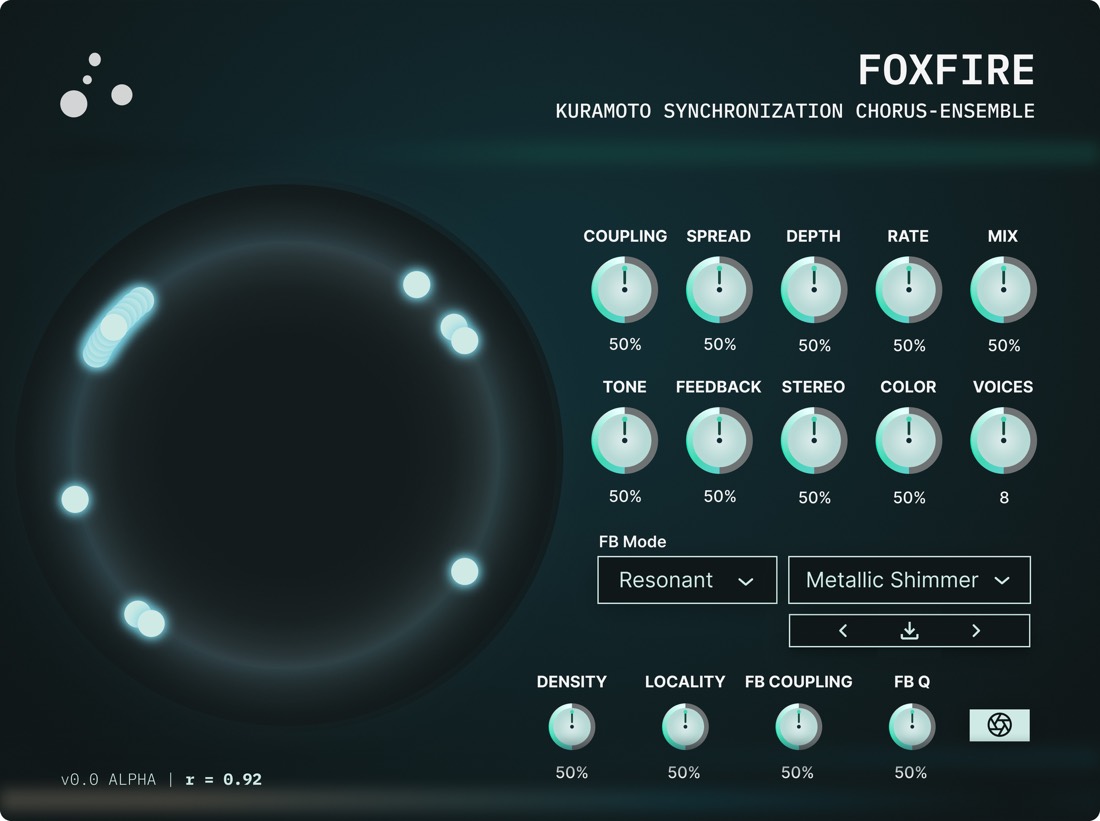
Foxfire plugin interface, showing the sync visualizer ring, the COUPLING / SPREAD / DEPTH / RATE / MIX knob row, the TONE / FEEDBACK / STEREO / COLOR / VOICES row, FB Mode and preset selectors, and the DENSITY / LOCALITY / FB COUPLING / FB Q row Live sync visualizer Coupling Voices · up to 16 Density · ensemble width
Live · order parameter
0.1816 voices · K = 0.30

This is the plugin's interface. The mechanism behind it: coupling rises until the voices lock, and the order parameter r climbs from 0 (a wide wash) toward 1 (full phase lock). For the underlying model, read Kuramoto synchronization in audio.

Foxfire treats the chorus as an ensemble of coupled oscillators, not a bank of independent LFOs. Each voice integrates dθᵢ/dt = ωᵢ + (K/N) Σ sin(θⱼ − θᵢ), so the beating, the partial-sync clusters, and the final lock are consequences of the coupling strength K, not scripted effects. For the practical category comparison, read Foxfire vs. chorus, phaser, and ensemble.

From a wide wash to a single locked voice.

01 · drift

Wash

Voices wander at their own rates. The result is a wide, shimmering ensemble.

02 · couple

Pull

Raise coupling and neighbors begin to influence each other. Beating emerges.

03 · lock

Synchronize

Past the critical coupling the ensemble snaps into phase, vibrato-tight.

04 · break

Cluster

Back off and the lock breaks into breathing partial-sync clusters.

What Foxfire does differently.

Inter-voice coupling.
No independent LFOs. The voices interact in real time, which is what it means for oscillators to be coupled. The field self-organizes instead of being driven from outside.
A real phase transition.
A single Coupling knob traverses the incoherent, critical, and locked regimes. You can park the knob on the transition and hold the sound at the edge of lock.
Chimera states.
Synchronized and desynchronized populations coexist inside the ensemble, a regime conventional chorus effects cannot reach.
Signal-driven feedback.
The processed audio feeds back into the phase dynamics, so the sound itself shapes the oscillator network rather than tracking a fixed LFO.

Hear it lock.

Dry / processed A/B

Each demo pairs the same source dry and processed. Toggle between takes to hear coupling and modulation depth step up.

Filtered analog pad
Sustained, filtered pad on a downward chord progression.
0:00

Downward chord progression, dry.

Piano · Moving On
Mid-range, mid-velocity piano in B minor.
0:00

Dry piano phrase.

Piano · Neighborhoods
Mid-range, high-velocity piano in C# minor.
0:00

Dry piano phrase.

Saw chords · filter sweep
Sustained saw chord progression, downward filter sweep.
0:00

Dry mix.

A few more sources captured under a single setting. No dry pair, just the plugin doing what it does.
Lead
Expressive line, vibrato with residual jitter.
0:00
Vocal
Doubling that breathes.
0:00
Pluck · guitar
Natural body, shimmer across transients.
0:00

What is in the box.

Synchronization engine
Kuramoto coupling across up to sixteen voices. Coupling, Spread, Depth, Rate, Mix; Tone, Feedback, Stereo, Color, Voices. Feedback modes and 25 factory presets.
Output
Density, Locality, FB Coupling, FB Q. The order parameter is shown live on the ring visualizer. Every control position is a valid operating state.
Formats
macOS 11+ VST3, AU, Standalone. Windows 10+ VST3. Apple Silicon and Intel native.
Foxfire
Catalog V1 · Launch special
$25$40